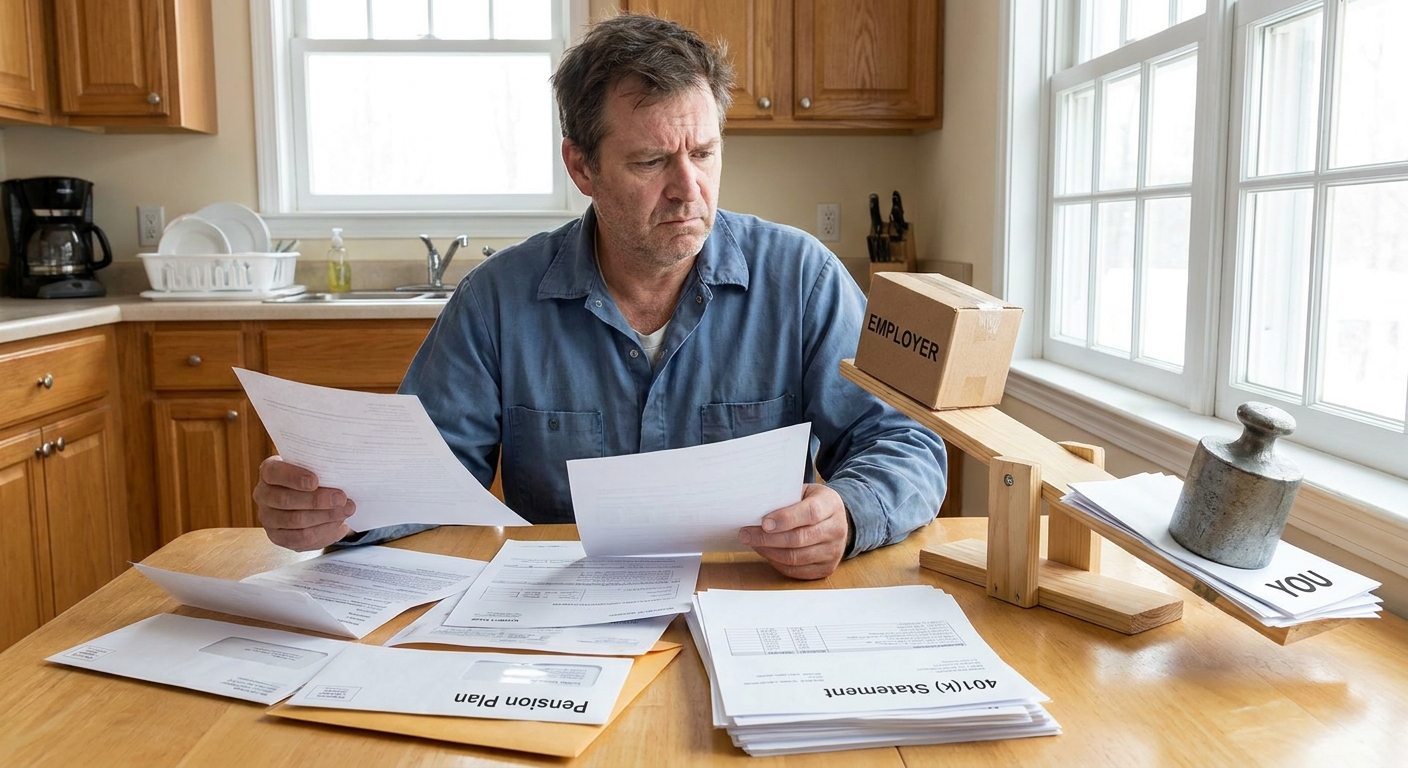
Over the past four decades, American retirement has undergone a fundamental shift—one that most workers never explicitly voted for.
The Silent Retirement Revolution You’re Already Living Through
The move from defined-benefit pensions to defined-contribution plans like 401(k)s has quietly transferred the core risks of retirement—from employers and governments to individual households.
In today’s volatile economic environment of higher inflation and interest rates, the consequences of that shift are clearer than ever: if the markets stumble or you mis‑calculate, there is increasingly no backstop.
Understanding how this transition happened—and what it means for your budget and savings now—is essential to protecting your future.
What Changed: From Promised Checks to DIY Nest Eggs
Yesterday’s Model: Defined-Benefit Pensions
In a traditional pension system, common in mid‑20th‑century America:
- Your employer promised a specific monthly benefit in retirement, often based on salary and years of service.
- The employer (and sometimes a union) bore the investment and longevity risk—the risk that investments under‑performed or retirees lived longer than expected.
At their peak in the late 1970s, defined‑benefit pensions covered nearly 40% of private‑sector workers.
Today’s Model: Defined-Contribution Plans
With 401(k)s and similar accounts:
- The employer offers a plan and often a match, but not a guaranteed benefit.
- You decide how much to contribute and how to invest.
- You bear market risk, inflation risk, and longevity risk.
As of recent data, only around 15% of private‑sector workers have access to traditional pensions. Meanwhile, more than 60 million workers are covered by 401(k)‑type plans.
Why the Shift Happened: Costs, Demographics, and Politics
Three forces drove the move away from pensions:
Rising Costs of Longevity
People are living longer. A 65‑year‑old today can expect to live about 19–21 more years on average, and many will live into their 90s. That made long‑term pension promises increasingly expensive for employers.
Volatile Markets and Low Rates
In the 2000s and 2010s, low interest rates squeezed pension fund returns. Companies had to contribute more to meet promises, hitting profits.
Regulatory and Accounting Changes
Rules changed to require companies to more accurately reflect pension liabilities on their balance sheets, making them look riskier to investors.
Faced with these pressures, many employers froze or closed pensions and leaned into 401(k)s, which cap the employer’s obligation at contributions rather than guaranteeing a lifelong income.
What This Means for Your Retirement Risk Today
The move to 401(k)s doesn’t just change where your money sits. It changes the nature of your risks.
1. Investment Risk Is Now Personal
With a pension, bad markets were the employer’s problem. With a 401(k):
- A bear market just before or early in retirement can permanently reduce your standard of living.
- Choosing an overly conservative portfolio in your 30s and 40s can leave you short by hundreds of thousands of dollars.
Example: Two workers each save 10% of a $70,000 salary for 30 years. One earns 5% annually; the other earns 7% by taking more stock exposure early on.
- At 5%: ≈ $441,000
- At 7%: ≈ $663,000
That’s a $222,000 difference purely from investment choices.
2. Longevity Risk Is on Your Shoulders
Pensions were designed to pay for life, no matter how long you lived.
With a 401(k), you must decide:
- How much to withdraw each year.
- How to invest as you age.
- What happens if you live 5, 10, or 15 years longer than expected.
Misjudging by even a few years can mean running out of savings late in life.
3. Inflation and Interest Rate Risk Hit Directly
In today’s environment:
- The 15%–17% rise in prices over the past three years directly erodes the purchasing power of your 401(k) balance.
- Higher interest rates help your bond and CD yields but can drag on stock and housing prices.
Pension plans sometimes offered cost‑of‑living adjustments. Your 401(k) does not—it’s just a pot of money whose real value moves with the economy and your decisions.
The New Reality: Most Households Are Under-Saved
The data suggest many workers haven’t fully adjusted to this risk transfer.
Broadly cited industry estimates show that for workers nearing retirement (ages 55–64):
- Median combined retirement savings are often well under $200,000.
- Even including home equity and other assets, many households fall short of the capital needed to sustain a modest middle‑class lifestyle.
Consider: At a 4% withdrawal rate, $200,000 generates only $8,000/year before taxes. Even combined with Social Security, that leaves little margin in a world where a single year of assisted living can cost $50,000–$70,000 or more.
How to Protect Yourself in the 401(k) Era
You can’t reverse the shift from pensions, but you can respond strategically.
1. Treat Your 401(k) Like a Pension You Control
- Aim for a clear target: Many planners suggest saving enough to replace 60%–80% of pre‑retirement income when combined with Social Security.
- Use rules of thumb cautiously, but as a starting point, target accumulating 8–12 times your final salary by retirement age.
If you expect a final salary of $90,000, that implies a nest egg of $720,000–$1.08 million.
2. Increase Savings Rates in Line with Economic Reality
Given longevity and uncertain markets, old advice to save 10% of income may be outdated for many.
- If you’re under 35 and starting early: 15% of gross income (including employer match) is a solid baseline.
- Ages 35–50: push toward 15%–20%+ if you’re behind.
- Over 50: use catch‑up contributions; 20%–25% may be necessary if starting late.
3. Use Age-Appropriate Investment Mixes
Target‑date funds, which automatically shift from stocks to bonds as you age, can be a good default for many workers who don’t want to actively manage portfolios.
However, in a higher‑rate world:
- Bonds and cash are more attractive than they were when they yielded 1%.
- But they still may not grow enough alone to outpace inflation over decades.
Rough guidelines (to tailor, not blindly follow):
- Under 40: 70%–90% in stocks; rest in bonds/cash.
- 40–55: 60%–75% in stocks.
- 55–70: 45%–60% in stocks, depending on risk tolerance and other income sources.
4. Consider Turning Part of Your 401(k) into a Personal Pension
As you near retirement, you can convert a portion of your nest egg into lifetime income using annuities.
- A single premium immediate annuity (SPIA) can offer a fixed monthly payment for life in exchange for a lump sum.
- Higher interest rates generally mean higher annuity payouts than during the low‑rate 2010s.
Example: A 67‑year‑old might turn $200,000 into roughly $12,000–$16,000 per year for life, depending on rates, provider and features.
This doesn’t replace careful planning but can reduce the risk of outliving your savings, especially for essential expenses.
5. Don’t Forget Social Security Strategy
Social Security is now the closest thing most Americans have to a traditional pension.
- Claiming at 62 permanently reduces your benefit by up to 25%–30% versus full retirement age.
- Delaying to 70 can increase your benefit by roughly 7%–8% per year after full retirement age.
In a world where your 401(k) is exposed to markets, securing a higher, inflation‑adjusted Social Security base is one of the most powerful ways to reduce retirement risk.
The Bottom Line: The Burden Has Shifted—Your Strategy Must Too
The dismantling of private‑sector pensions and rise of 401(k)s have changed who carries retirement risk. In today’s volatile environment, failing to acknowledge that shift is dangerous.
You’re now the chief investment officer, risk manager and actuary of your own retirement.
Your response should be:
- Higher, more consistent savings rates.
- Thoughtful, age‑appropriate investment choices.
- Strategic use of Social Security timing and, where appropriate, annuities.
The system won’t guarantee your retirement. But by understanding the economic forces behind this shift and acting deliberately, you can rebuild some of the security pensions once offered—on your own terms.