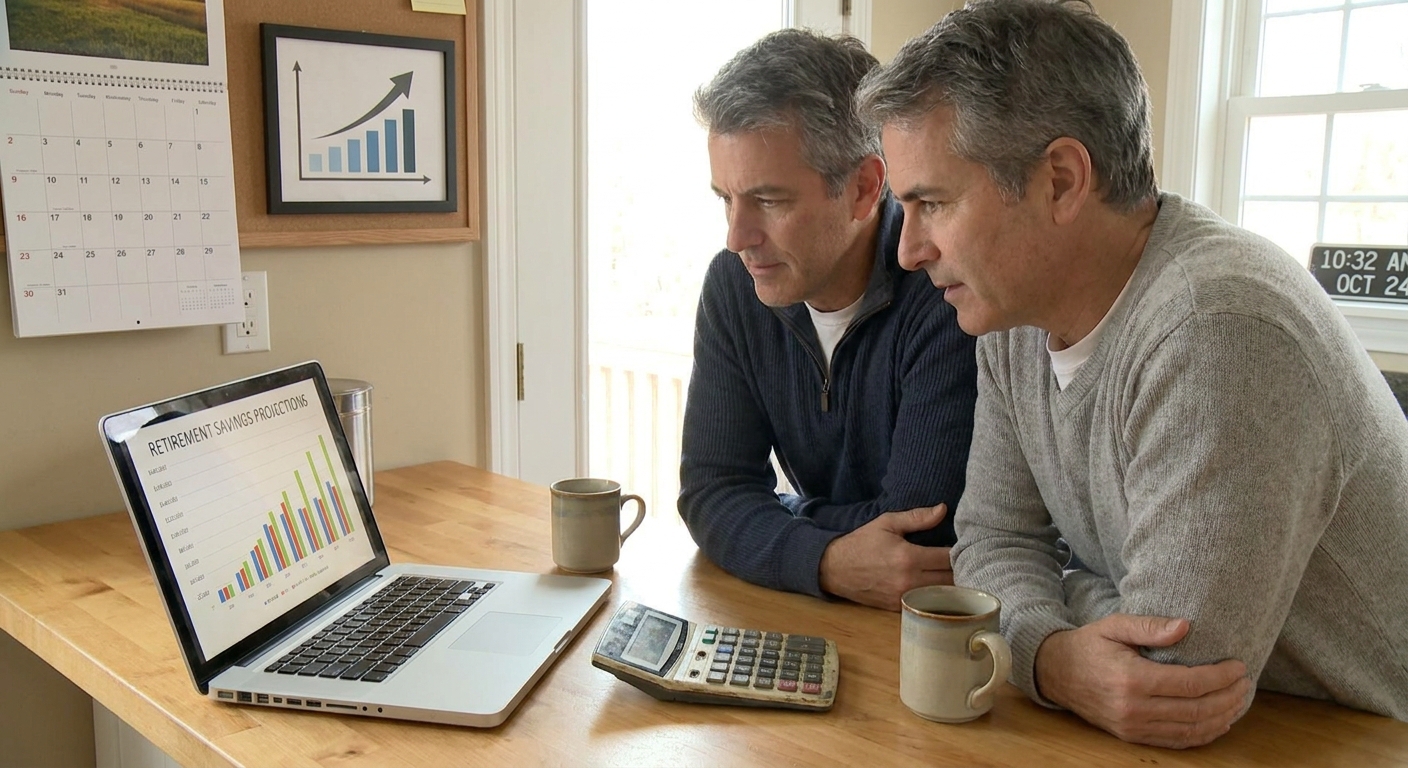
Retirement planning for American households is being quietly rewritten by one number: interest rates.
The Retirement Calculus Just Changed – Again
After more than a decade near zero, the Federal Reserve pushed its benchmark rate sharply higher beginning in 2022 to fight inflation. As of late 2024, key rates are still elevated compared with the 2010s: the federal funds rate sits in the 4.75%–5.5% range, down from recent peaks but far above the 0%–0.25% levels many savers grew used to.
That shift is changing how much you need to save, how safe your nest egg really is, and what kind of returns you can realistically expect.
This is not an academic issue. For a household hoping to retire on $60,000 a year in today’s dollars, the difference between earning 2% and 5% on safe assets can mean needing hundreds of thousands of dollars more—or less—by the time you stop working.
What’s Happening: From Free Money to Real Yields
For most of the 2010s, cash and bonds paid almost nothing. A typical high‑yield savings account paid 0.5%–1%. Many safe bonds yielded 2% or less after fees. Retirees and near‑retirees were pushed into stocks and riskier investments to generate income.
Today, the picture is different:
- Online savings accounts often pay 4.0%–4.5% APY.
- 1‑year Treasuries and CDs can yield around 4.5%–5.0%.
- Investment‑grade corporate bonds yield 5%–6% in many cases.
At the same time, inflation—while off its 2022 highs—has not returned to the ultra‑low pattern of the 2010s. Over the past three years, consumer prices have risen roughly 15%–17% in total, meaning that a retiree’s cost of living is permanently higher even if future inflation moderates.
The result: your retirement savings now face a double squeeze—they must stretch further to cover higher prices, but they also have more opportunity to earn safe income than they did a few years ago.
The Old 4% Rule Under Pressure
For decades, financial planners relied on the "4% rule": in retirement, you could withdraw 4% of your portfolio in year one, adjust that dollar amount annually for inflation, and have a good chance your money would last 30 years.
In a low‑rate world with expensive stocks, many experts argued that 4% was too aggressive. Some suggested 3%–3.5% was safer.
With higher rates, the picture is mixed:
- Safe assets pay more, which supports sustainable withdrawals.
- Volatility and inflation risk are higher, which can threaten portfolios in bad markets.
A simple example shows how the math works:
- Suppose you want $60,000 in annual pre‑tax income from your investments.
- Under a strict 4% guideline, you’d need:
- At a more conservative 3.5%:
$60,000 ÷ 0.04 = $1.5 million.
$60,000 ÷ 0.035 ≈ $1.71 million.
On paper, higher bond yields might support 4% again. But if your expenses—housing, healthcare, groceries—are rising faster than expected, you may still need to plan cautiously.
How Higher Rates Affect What You Need to Save
The new rate environment changes three key variables in your retirement plan:
1. Growth on Pre‑Retirement Savings
If you’re 15–20 years from retirement, the return assumptions you use matter enormously. Consider $500 per month saved for 25 years:
- At a 5% annual return:
- At a 7% annual return:
Future value ≈ $297,000
Future value ≈ $406,000
That’s a $109,000 difference from just 2 percentage points of return.
Higher rates can support higher expected returns on balanced portfolios, but they can also lead to stock market volatility and slower economic growth. The prudent move: use moderate assumptions (5%–6% after inflation for a diversified stock‑heavy portfolio) rather than banking on the double‑digit gains of bull markets.
2. Safe Income in Retirement
Retirees no longer have to accept 0.5% yields on cash. A $500,000 portfolio invested half in stocks and half in bonds and CDs might reasonably generate $20,000–$25,000 per year in interest and dividends at current yields, versus $10,000 or less a decade ago.
That extra income can:
- Reduce pressure to sell stocks in down markets.
- Lower the total portfolio size needed to support a given lifestyle.
But it also means your strategy must be actively updated to capture better yields instead of sitting in old, low‑yield accounts.
3. The Real Cost of Delaying Savings
When inflation runs hotter, every year you wait to save, the target gets further away:
- If you estimate needing $1 million to retire at today’s prices and inflation averages 3% for 20 years, you’ll actually need about $1.8 million in nominal dollars.
Waiting five years to start saving means you must contribute much more later to catch up to a larger future price tag.
Impact on Household Budgets, Mortgages, and Paychecks
Budgets
Higher prices for essentials like housing, food, and utilities have permanently raised the "floor" of retirement spending. If you once thought you could retire comfortably on $40,000 a year, you may now realistically need $50,000–$55,000 just to maintain the same standard of living.
Mortgages and Debt
- New mortgages: A 30‑year fixed mortgage that was 3% in 2021 has hovered near 7%–8% lately. On a $400,000 mortgage, that’s the difference between roughly $1,686 per month (principal and interest at 3%) and $2,935 at 7.5%—about $1,250 more every month.
- For retirees: entering retirement with mortgage or credit card debt is now substantially more expensive and eats directly into your income.
Paychecks
Higher rates and tighter financial conditions can slow hiring and wage growth. If your salary isn’t keeping pace with recent inflation, your ability to save is being eroded.
If inflation averaged 5% over three years while your wages rose just 3% annually, your real purchasing power fell by several percentage points.
Practical Takeaways: What to Do Now
1. Re‑Run Your Retirement Numbers at Today’s Rates
- Use conservative return assumptions: 4%–5% real (after inflation) for long‑term stock‑heavy portfolios, 1%–2% real for bonds and CDs.
- Update your target retirement income for current prices—don’t rely on estimates from five years ago.
2. Capture Higher Yields Safely
- Move idle cash from checking or low‑yield savings to FDIC‑insured high‑yield savings or Treasury bills where appropriate.
- Ladder CDs or Treasuries (e.g., 6‑, 12‑, 24‑month maturities) to balance yield and flexibility.
3. Prioritize High‑Rate Debt Paydown
- Focus on paying off credit cards with 20%+ APRs and variable‑rate personal loans.
- Consider accelerating your mortgage payoff only after high‑interest debts and retirement contributions are on track.
4. Adjust Retirement Age and Contributions
- If recent inflation has blown up your plan, a 2–3 year delay in retirement can meaningfully improve sustainability.
- Aim to save 15%–20% of gross income if you’re in your 30s or 40s, more if you’re starting later.
5. Stress‑Test Your Plan
Run three scenarios:
- Base case: Moderate returns, 2.5% inflation, retire at your target date.
- Adverse case: Lower returns, 3.5% inflation, market downturn in first 5 years of retirement.
- Upside case: Strong returns, 2% inflation, working 2 extra years.
If your plan only works in the upside case, it’s too fragile.
The Bottom Line
Higher interest rates are reshaping retirement planning in ways that cut both ways: they hurt borrowers and late savers but reward households that adapt quickly and capture safer income.
Your action items: revisit your numbers, increase your savings rate if possible, shift idle cash into higher‑yield vehicles, and reduce high‑cost debt. The economy has changed. Your retirement playbook needs to change with it—now, not five years from now.